THE HISTORY OF SEA SHANTIES
 These men sailed all over the world in such endeavors as the India trade and whaling. The shanties were in English so there it is easy for us.
The French, Nordic, Germans, etc. also had shanties. I speak French, but most others around me don't so I won't get into French chanties yet. By the way, the word "chant" means "sing" in the French language. Coincidence?
Perhaps not.
These men sailed all over the world in such endeavors as the India trade and whaling. The shanties were in English so there it is easy for us.
The French, Nordic, Germans, etc. also had shanties. I speak French, but most others around me don't so I won't get into French chanties yet. By the way, the word "chant" means "sing" in the French language. Coincidence?
Perhaps not.
Some shanties were changed through the centuries, to become what we have now. The kinds of work defined the type of shanty. The forecastle itself was also called the shanty as in a structure.
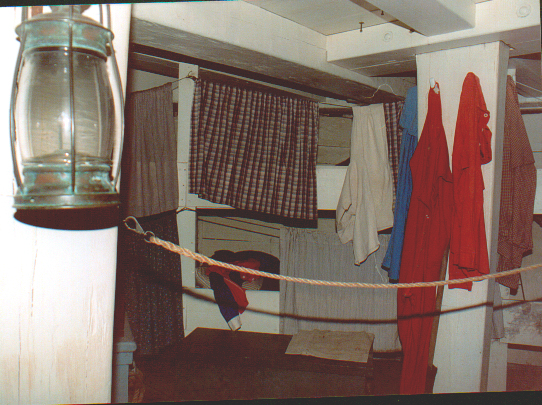
Note the cramped quarters
in this partial view of bunk beds, etc. as well as a wood stove in the foreground.
This was used for heat.
This is below deck on the Charles W Morgan, the last wooden, American whaler.
A forecastle shanty
(pronounced foke-sal) or a forebitter are the same. They were sung usually when waiting around between bouts of hard work. Their time off was spent with these songs of home or romantic business or of betrayal by a wench on shore or military battles, as well as popular songs of the day.
The dead horse shanty
Was sung with the men all together, when a man paid off his debt to the ship for his supplies. Some were for crossing the equator.
A sea shanty or chanty is a work song
In the same way, Chinese coolies had work songs and the way the African slaves of the south had work songs so too did the sailors and whaling men and dockhands of the era.
The tradition spanned many years.
The first shanties found were in early texts
written by a monk describing a chant sung to the job of work done by the sailors on
his trip to the Holy land from England in the (1400's?).
It was many moons ago.
The 1700's and 1800's brought us the most memorable shanties. Most shanties that we hear came from England, Ireland and USA although every maritime country had them.
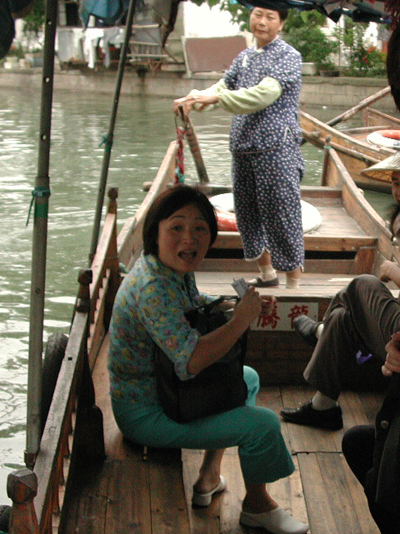
I was being rowed on a sampan sort of boat in Suzhou China, and the woman was singing a Chinese language Sea Shanty!
That was a memorable time!
See the Charles W Morgan in Mystic Connecticut.
I had been aboard the Charles W Morgan in Mystic, CT in the past.
She was built in 1841 in New Bedford, Ma by Jethro and Zachariah Hillman and sailed 37 trips, some lasting longer than 3 years.
She weighs 351 tons, is 106, 1/2 feet long and 27 feet, 2 1/2 inches wide. She is 13 feet 7 1/4 inches deep.
She brought home to New Bedford many barrells of right whale oil, sperm oil and whale bone.
The summer of 2014 brought her on her 38th trip back to her original New Bedford docks where she hosted tours for many folks who learned about the whaling ship.
She was there for several days and everyday there was a line to get aboard her.
If you are in the Mystic area take some time to learn about the old history of the whaling days at the museum where the ship lives.
Mystic Seaport 75 Greenmanville Ave. Mystic, CT 06355 - tel 860.572.0711 | 888.973.2767 | info@mysticseaport.org
To the left is a nice 1926 video about the Charles W Morgan from a friend, M. L. Baron of West Island, Fairhaven, Ma.
Short Drag Shanty: For tough jobs where men worked shorter distances such as raising a masthead or trimming sails.
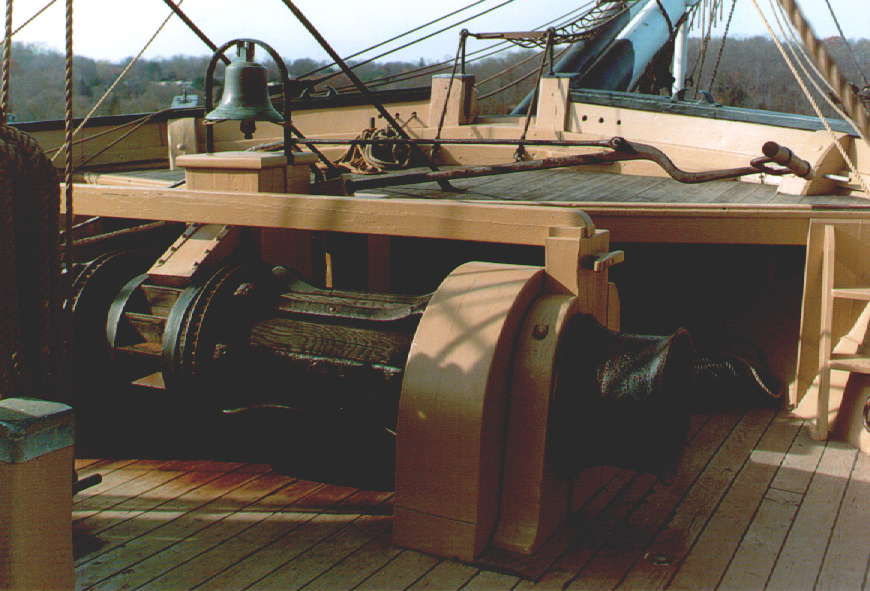
A Capstan Shanty
Used when working the large vertical drum with a mushroom shape on the top which had holes for the bars that were inserted to push the capstan around and around.
So, they worked in a circle.
They would stamp on deck at times with the rhythm, therefore, "Stamp & go Shanties".
That, for one thing, wound up the anchor chain.
Halyard Shanty:
Was used with a grunt or a stressed word at a part of the song to accentuate the coordinated pull.
The work couldn't be done if not in a timed, concerted effort. The halyard raised the yard to which the sails were hung.
Despite the advantage of block and tackle, some could weigh over a ton.
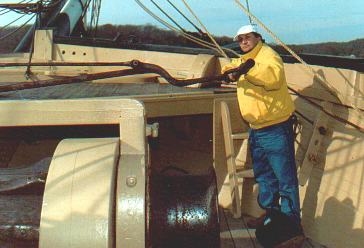
Here's Roger Chartier on the windlass of the Charles W Morgan most often docked in Mystic, CT. The summer of 2014 found her sailing to New Bedford, Ma, Provincetown, etc.
Windlass and Pumping Shanties: A windlass is shaped like a barrel on it's side, horizontally that is, with handles at either end. Handles were worked up and down. On pump brakes, (downtown pumps) an eye splice on the end of a rope was fitted over the end of a handle so that several men could work on it together.
This was called a bell rope. The sailors pulled this in teams.
The way shanties are played today is sometimes in a fun, yahoo sort of way. That is not the way the sailors etc. of the time used them to do a slower, more laborious job of work. Surely they did raise hell on occasion.
We shanty singers are not working when we sing them, we are both presenting a piece of history and oft times having fun. So the presentation again, has changed just a little.
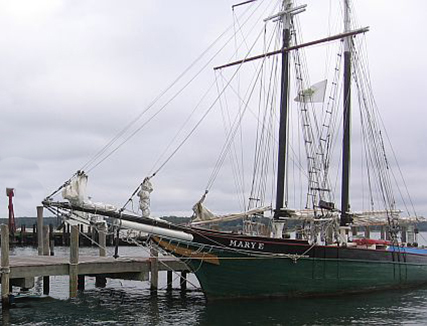
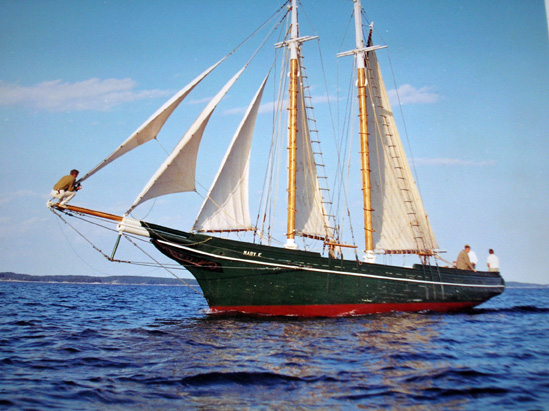
The Mary E
Actor Sterling Hayden was once a member of her crew. In 1975, she was chartered by the National Park Service. She cruised from New York to Florida and back teaching marine sciences and teaching sailing to thousands of school kids at national parks along the way. In Op Sail 76, she was the oldest U.S. Flag vessel in the tall ships parade.
"Mary E" - built 1906 - Bath Maine
This ship is reported to be the last of over 4000 Maine built clipper schooners.
I sailed on her with Jazz music's great man Captain Captain Ted Charles out of Key West on and off during one winter in the 90's.
Ted really played the vibes like a super pro and had been in a lot of the top, and quite famous big bands in his life.
I had the role of ships musician/singer, providing musical entertainment for the passengers on the beautiful 2 1/2 hr. sunset cruises. It was too much fun!
Ted was in his 60's when in Florida - one day - he put on a sweater (his version of a wet suit) and dove over the side with caulking and a hammer to plug a small underwater leak in the vessel.
He succeeded.
Mary E's first 50 years she worked at ocean sword fishing out of Block Island under the skillful hand of Captain Dunne. During WW2, she successfully ran mail and freight from Newport to Block island, repeatedly evading the Nazi U boat blockade.
Fortunately you can see the web site for the Mary E. out of Greenport Long Island. www.SchoonerMaryE.org - It is here online!
CAPTAIN ROGER'S RECIPE FOR GROG
1 Cup or mug2 Shot of rum
3 Teaspoon of powdered sugar
4 Lime juice - Squeeze a piece of lime to prevent scurvy.
5 Cinnamon stick.
6 Boiling water (fill 'er up)
7 Let it cool enough, then ... Drink Hearty Mates!